

DeFi Outsources Its Most Important Feature
Stablecoins processed trillions in transaction volume last year exceeding Visa and Mastercard combined. The world noticed.
Stripe launched Tempo, a payments-focused chain for stablecoin settlements, with Klarna already building a USD stablecoin on it.
Revolut added stablecoin conversion, essentially stableswaps, but instant and feeless.
Bridge.xyz was acquired by Stripe to build regulated stablecoin orchestration, making fiat→crypto feel like moving money between bank accounts.
These aren’t crypto-native teams fumbling through DeFi. These are operators who’ve built world-class financial infrastructure, now entering with regulatory clarity (GENIUS Act, upcoming CLARITY Act) and the integrations that make things just work.
CeFi’s offer: Trust us, and we’ll give you convenience and efficiency.
DeFi’s offer: Trust no one, but figure out the last mile yourself.
That trade-off worked when TradiFi wasn’t here. Now they’re here. And they’re not fumbling.
The Real Problem: Last-Mile Connectivity
Here’s what DeFi ignores:
Users don’t live on-chain. They have bank accounts. They pay rent. They receive salaries. They want to buy coffee.
DeFi has punted the last mile to CeFi players. Need to on-ramp? Go to Coinbase. Need to off-ramp? Use a centralized exchange. Need to pay someone in fiat? Leave the ecosystem entirely.
The trustless part of DeFi ends exactly where users need it most: at the boundary between crypto and everything else.
Meanwhile, CeFi is building that bridge and extracting the value from it.
The Dogma: DeFi Cannot Touch Fiat
@0xalpo’s post on the L1 dilemma frames it well: new L1s win by attacking incumbent dogma.
The current dogma is that DeFi protocols cannot, should not, touch fiat rails. That’s CeFi’s domain. DeFi stays pure, stays on-chain, stays trustless.
But this dogma cedes the most valuable part of finance to centralized players.
When Patrick Collison was asked on Hacker News why businesses find crypto useful, his response cut through years of noise:


Businesses want programmable money. They also want it to reach bank accounts, pay invoices, settle cross-border. Today, the permissioned infra players capture this value.

Hotstuff’s Answer: Uber for Financial Access
Uber solved last-mile connectivity in transportation. Hotstuff solves last-mile connectivity for financial access.
The thesis is simple: Move money for as many people, as fast as possible. In as many jurisdictions and currencies as possible. Trustlessly.
How? By making validators into financial service providers.
Validators partner with regulated stablecoin orchestration platforms like Bridge.xyz. These platforms handle the regulated pieces: banking relationships, compliance infrastructure, fiat rails.
The user flow:
User wants to off-ramp $10,000 USDC to their bank
User completes KYC with the underlying provider (Bridge, etc.) not with Hotstuff
The network matches user to a validator operating with that provider
Validator’s KYB’d account processes the transaction
Routing happens trustlessly on-chain
User receives fiat
The Uber model: Validators using the same or different providers compete like cab drivers. Same customer need, multiple drivers bidding on service. Competition on speed, rates, service quality, geographic coverage.
The routing is trustless. The underlying service requires compliance. Hotstuff doesn’t need banking licenses validators partner with those who have them.
DracoBFT: The Consensus Layer That Enables This
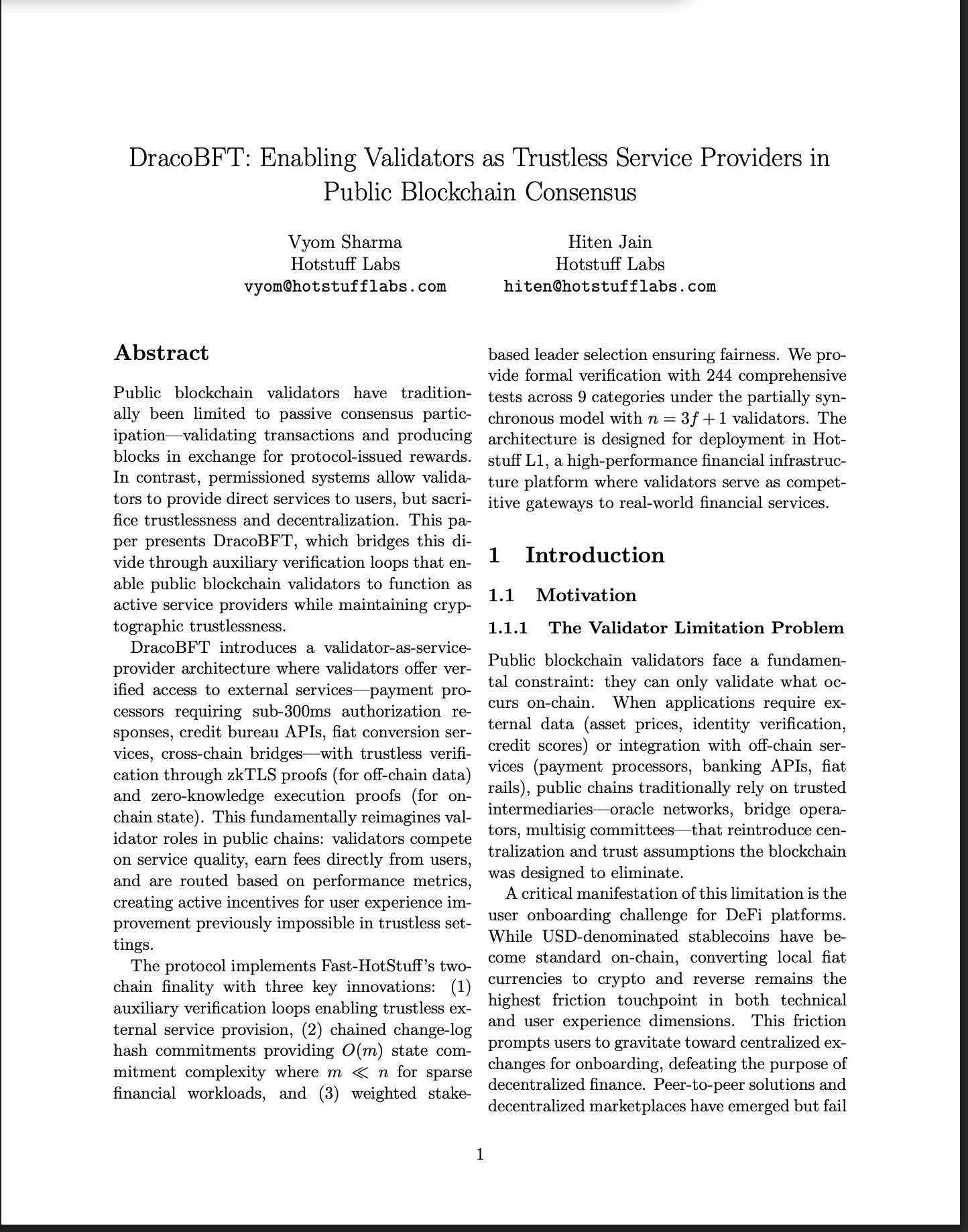
DracoBFT starts from the HotStuff family stake-weighted leader selection, pipelined block production, two-chain deterministic finality, partial synchrony with n = 3f + 1 Byzantine tolerance.
200k+ TPS. 75ms block time. 150ms finality.
Sub-second, deterministic. No probabilistic tail. No 12-second voting windows.
But that’s table stakes. The real deviation is in what happens outside the consensus loop.
Key innovations:
HotStuff-family BFT: Pipelined, 2-round deterministic finality
Chained Change-Log Commitments (CLH): Only hash keys that changed per block instead of recomputing a global state root
Side-loops: Auxiliary execution domains where validators do real-world work without blocking consensus
Side-Loops: Validators as Service Providers
Here’s what we built that nobody else has.
Traditional blockchains externalize real-world interaction into separate systems:
Oracles fetch prices and submit them on-chain
Bridges lock assets on one chain and mint on another
Payment processors handle fiat through custodial rails
API relayers call external services and hope you trust them
These components sit outside consensus. They operate on reputation, multisigs, and “trust us” security models. When Chainlink nodes report a price, you’re trusting that enough of them aren’t lying. When you use a bridge, you’re trusting the operators won’t rug.
DracoBFT introduces side-loops: auxiliary execution domains where validators perform real-world operations without blocking consensus.
What kind of operations?
zkTLS verification: Validators prove API responses came from specific servers cryptographically. Not “we asked 20 nodes and took the median.” Actual proof this data came from Chase, from Coinbase, from wherever.
Cross-chain state verification: Verify state proofs from other chains as validator duties, not bridge operator trust.
Private computation: Compliance checks, identity verification, sensitive financial logic off main chain but cryptographically bound to it.
Payment routing: Validators directly route payments, operate fiat on/off-ramps, and get paid for doing so.
Crucially, these tasks do not block consensus. A validator working on a side-loop task doesn’t slow down block production. The core chain keeps humming at 75ms blocks. When the side-loop work completes, the validator submits a compact cryptographic proof back to the main chain.
External execution becomes:
Trust-minimized: Cryptographic proofs, not reputation
Non-blocking: Parallel to consensus
Economically native: Validators get paid for services, not just block rewards
Chained Change-Log Commitments (CLH): Why State Matters for Financial Workloads
Every blockchain needs to commit to its state prove that current balances, positions, and data are correct. Ethereum and most chains use full Merkle state roots: recompute the entire tree, hash it, commit.
This works. But for high-frequency financial workloads, it’s wasteful.
Think about a trading system. In a 75ms block, maybe 10,000 orders execute. But total state all accounts, all positions, all balances might be millions of entries. Recomputing a full Merkle root every block means hashing data that didn’t change.
DracoBFT uses Chained Change-Log Commitments (CLH).
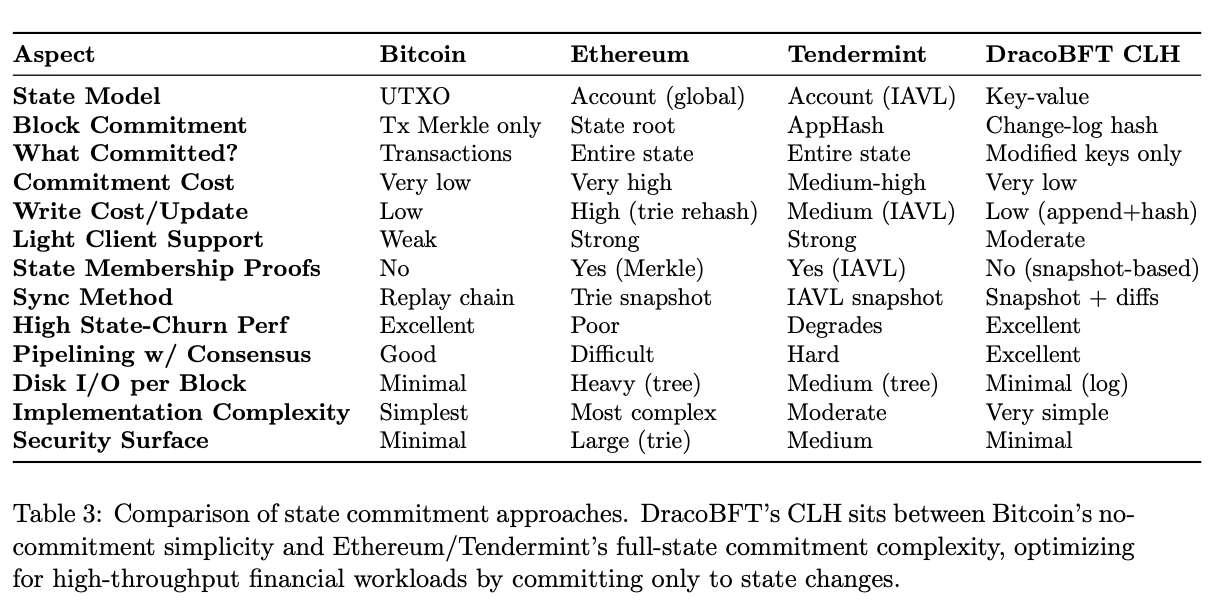
Only the keys modified in a block get hashed and chained forward. If your account didn’t change this block, we don’t touch it. The commitment chain grows incrementally, not recomputed globally.
For financial workloads where a small portion of state changes per block but latency requirements are strict, this is the difference between “we can theoretically handle this throughput” and “we can handle this throughput at the latency real trading demands.”
The Economic Innovation: Validators as Service Operators
In every other chain, validators have one job: participate in consensus. They get paid block rewards. Maybe they extract MEV. That’s the economic model.
DracoBFT introduces a second economic axis.
Validators can directly provide:
Payment routing
Fiat on/off-ramps
API verification services
Cross-chain bridge operations
Execution services for complex financial logic
And they’re paid directly by users for those services.
This isn’t “validators can also run side businesses.” This is protocol-native. The services are cryptographically verifiable. The payments flow through the chain. The quality is measurable by uptime, latency, reliability all become staking considerations.
What does this mean in practice?
A validator isn’t just competing on “I have the most stake.” They’re competing on “I provide the fastest fiat rails” or “I have the most reliable API verification” or “I route cross-chain payments with the lowest latency.”
Service-level economics, not just security-level economics.
This changes the game theory. It changes who wants to be a validator. It changes what validators are worth.
Why We Built This From Scratch
We could have forked HyperBFT. We could have tweaked Tendermint. We could have built on LibraBFT and called it a day.
We didn’t.
Because the changes we needed weren’t incremental. You can’t bolt side-loops onto a consensus mechanism designed without them. You can’t add CLH commitments to a chain that assumes full Merkle roots. You can’t make validators into service operators when the protocol treats them as consensus-only participants.
DracoBFT is a ground-up redesign. Same theoretical foundation BFT, pipelining, partial synchrony. Completely different assumption about what validators are for.
Built to Iterate Fast: The Speed of Experimentation
One thing that doesn’t get enough attention: DracoBFT is built to iterate fast.
The side-loop architecture means we can add new validator capabilities without consensus changes. Want validators to verify a new type of API? That’s a side-loop addition, not a hard fork. Want to add a new cross-chain verification method? Side-loop.
The CLH commitment structure means state management evolves independently of consensus.
The modular economics mean we can experiment with new service models new ways validators get paid, new services they provide without touching the core protocol.
This matters more than people think.
Crypto moves fast. The chains that win aren’t the ones with the best Day 1 architecture. They’re the ones that can adapt fastest without breaking what works.
We built DracoBFT to be the fastest-iterating consensus mechanism in the industry. Not just the fastest at ordering transactions, the fastest at becoming whatever the market needs next.
The Endgame
Our vision isn’t to be your preferred perp dex. It’s to provide a financial ecosystem where you:
Custody capital safely
Trade anything you want
Earn from yield opportunities
Route to and from fiat
Send, receive, spend your money
All with full confidentiality.
Not just a blockchain. Not just “another L1.”
A protocol where validators operate the infrastructure that connects crypto to the real world with cryptographic guarantees, not trust assumptions.
DracoBFT is the consensus layer that makes all of this possible. The side-loop architecture and TEE integration lay the groundwork for confidentiality at scale but that’s a story for Part 2.
Testnet live: testnet.hotstuff.trade
Website: hotstuff.trade
DracoBFT Whitepaper: hotstuff.trade/DracoBFT.pdf
Twitter: @tradehotstuff
This is Part 1 of our vision series. Part 2 will cover The Capital Efficiency Gap, why DeFi’s composability doesn’t compound, and what we’re building to fix it.