


HLV is our market-making vault. You deposit assets, the vault deploys them as liquidity across our orderbooks, and you earn returns via market-making and backstop liquidation flows.
This is democratized market making. Not yield farming with extra steps. It derives yield from real market structure - spreads, maker rebates and liquidation flows.
If you've used Hyperliquid's HLP, you understand the basic concept. But HLV goes further.
What Makes HLV Different
Hedge-Mode

HLV runs in hedge-mode for all markets. This means it can simultaneosly hold both long and short positions for any given perp at the same time.
In a delta-neutral setting, Running in hedge mode with per-account netting allows HLV to quote both sides of the book across all markets while only blocking margin on net delta plus a dedicated liquidator sleeve. Capital efficiency jumps by ~50% vs one-way vaults that must double-margin each strategy.
This allows HLV to double the amount of liquidity it can quote with the same of capital, boosting capital efficiency by 100%.
Multi-Venue Routing

HLP trades on Hyperliquid's books only. That's it.
HLV is designed to provide liquidity on hotstuff using a cross-exchange market making startegy which trustlessly quotes on:
Hotstuff's native orderbooks
Hyperliquid's books (when liquidity is better there)
CeFi venues like Binance & Bybit via off-exchange custody solutions like Copper's Clearloop, Ceffu, etc.
The vault sources liquidity wherever it's deepest. You get better execution and better returns because HLV won't be limited to a single venue.
How it works?
Recent innovations in the space have opened up gateways for trustless access to external venues. Hyperliquid itself is now a valid on-chain venue; major CEXs like Binance and Deribit support asymmetric API keys. Through DKG-generated EDDSA/ECDSA keys, HLV can quote simultaneously on Hotstuff, Hyperliquid, and supported CEXs, while DracoBFT’s aux loops ingest mark-to-market and risk data in near-real time via zkTLS web proofs. Rebalancing and basis trades follow the same trust model that already underpins large CeFi <> DeFi systems (e.g. off-exchange MPC clearing for @ethena_labs's USDe)
Read more about this in our whitepaper at
Hotstuff 🫶 Hyperliquid + HIP3
We are hyped to announce that Hyperliquid will become the first DeFi venue which will be integrated with HLV.
Initial deployment targets an Hyperliquid-only integration with phased CEX expansion after demonstrating operational stability.
More Details to follow in a later post.
The Risks
Let's be direct about risk.
HLV is a market-making vault. Market makers take the other side of trades. That means inventory risk if markets move violently against positions, the vault can lose money.
This is not a stablecoin yield farm. This is not a "safe" 5% APY product. This is exposure to market-making economics, which includes real downside.
Do your own research. Understand what you're depositing into.
What should you be excited about?
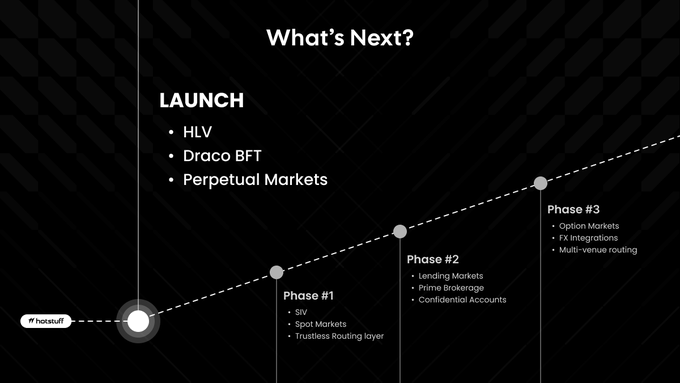
Here's what's coming: confidential vaults.
On public chains, vault strategies are visible. Competitors can see rebalancing activity. They can front-run. Alpha leaks.
With HLV on confidential rails, strategies stay private. Rebalancing doesn't get front-run. The result: better returns for depositors.
What next?
HLV deposits open in <72 hours with invite-only access.
Perps markets go live shortly after on Beta (days).
This is the beginning of the integrated DeFi venue we've been building at Hotstuff Labs.
To request access, go to app.hotstuff.trade
The architecture creating a bridge between on-chain execution and CEX liquidity via MPC/zkTLS is a massive step forward. Combining multi-venue routing with hedge-mode efficiency makes HLV essentially a hedge fund in a smart contract. Can't wait to see the yield stats vs vanilla HLP